

Cities and the Environment (CATE)

Cities and the Environment publishes peer-reviewed scholarship on the research, education, and practice related to the broad field of urban ecology. We encourage submissions of well-written, relevant articles across many article types. Please review the submission guidelines to prepare your manuscript.

This is an open access journal which means that all content is freely available without charge to the users or their institutions. Users are allowed to read, download, copy, distribute, print, search, or link to the full texts of the articles, or use them for any other lawful purpose, without asking prior permission from the publisher or the author. This is in accordance with the BOAI definition of open access.

We held the inaugural Cities and the Environment Symposium on November 20, 2025 in Los Angeles, CA, USA. Read the recap here, and check back in late 2026 for a special issue showcasing symposium proceedings.

CATE is under construction! We are refreshing our pages and adding new content from June-August 2026. You may notice changes to the format during this time. Please get in touch if you have questions.

Current Issue

Volume 19, Issue 2 (2026)View issue

Current Articles

  • ArticleCombined Estimation of Herpetofauna and Avian Detection Frequency in a Suburban Ecosystem in as a Function of Land Use Development
    19 August 2026Isabelle Barnes, Jake Gerardi, John Quinn
    Biodiversity is under threat as natural and semi-natural ecosystems continue to decrease in frequency and extent as a function of increased urban development, among other drivers. However, it has become clear that some levels of urban development can continue to support some biodiversity. However, it is not clear how species within different taxonomic groups may respond to similar types and extents of development. Thus, data are needed to assess relationships between urban development and multi-taxa detection patterns. To begin to address this gap, we conducted a concurrent analysis of anuran and avian diversity along an urban-to-peri-urban transect in Greenville, South Carolina, USA. To better align sampling for both taxonomic groups, we conducted passive acoustic sampling along ~10 km of the trail at 400 m intervals. We used unsupervised classification and manual identification to establish levels of detection frequency along the trail of each recorded species. We used geographic information systems (GIS) to establish proportions of land use and land cover including forest, wetlands, and development around each point. We used AIC model selection to identify the most informative land use and land cover variables for each species. There were fewer species detected when there was more development overall but it was varied for specific types of development. Avian and anuran species were detected more frequently in proximity to forests and wetlands, two ecosystem types that are increasingly lost in many urban areas. Moving forward, this data could be useful in the establishment of conservation policies and efforts concerning urbanization, forest fragmentation, and biodiversity in urban greenspaces not formally defined as protected.
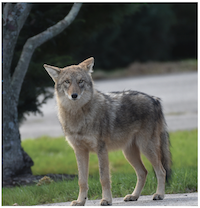
  • ArticleThe Effect of Anthropogenic Food Subsidies on Coyote (Canis latrans) Territory Size
    19 August 2026Numi Mitchell, Kyle Hess, Michael Strohbach, Ralph Pratt
    Context. Coyotes have confounded lethal-control efforts for over a century, initially as they preyed on livestock the Midwest rangelands in the early 1900s. In the past century, coyotes have expanded their range across the US into rural, suburban, even urban areas in the eastern US where populations are increasing along with calls for management from communities.  Here we examine anthropogenic food subsidy reduction as a possible management tool for coyotes. Compelling explanations for coyote territory-size variation have both a food-availability component and a contender pressure, or competition, component. These factors also influence pack group-size. Ultimately, competition for limited food resources may determine the density of the coyote population. Aims.  To explore this idea, we examined the effects of anthropogenic food resource availability on coyotes in urban, suburban, and rural areas in Rhode Island, USA. Methods. We GPS-collared and tracked 16 coyotes that were, and 15 coyotes that were not, heavily dependent on large, reliable anthropogenic food subsidies.  Anthropogenic subsidies used by coyotes included livestock or deer carcass dumps, farms with small free-range livestock, commercial restaurant garbage, and feral cat colonies.  We compared territory sizes for coyotes living in packs that exploited anthropogenic food subsidies vs. those that did not. Key results. In all cases, the territory sizes of resident coyotes with no detectable anthropogenic food subsidies were 59% larger ( = 11.9 km2) than those of coyotes with territories containing large reliable anthropogenic subsidies ( = 7.5 km2, 95% MCP home range; Wilcoxon test p=0.009).  The total area for high-use regions, or core areas, of unsubsidized coyotes also was 71% larger ( = 3.6 km2) than those with no detectable subsidies ( = 2.1 km2, 95% LSCV contours, p=0.005).  In five cases we were able to remove or add subsidies during the tracking periods of individual coyotes and achieved the same result: territory sizes were smaller when food subsidies were present and larger when subsidies were absent. Conclusions. Heavily food-subsidized coyotes defend smaller territories.  Coyote territories expand to support the group if subsidies are removed, or are absent.  Related research shows adult pack size stays relatively constant though these changes. It follows that the density of coyote packs, or reproductive groups, should increase when large reliable anthropogenic food subsidies are present and decrease when subsidies are removed. Management implications.  Reducing or eliminating anthropogenic food subsidies where they occur in communities with mixed rural-urban landscapes will very likely lower coyote population density. It is a non-lethal strategy for sustainable management of coyotes that leverages their inherent ability to adjust population size based on available food.
  • ArticleUrban Green Spaces Landscape Design for Improving the Cultural Ecosystem Services Satisfaction of Older People: Translating Maxent Model Outputs into Spatial Design and Design Code Refinement
    19 August 2026Huan Zhong, Takashi Machimura, Oyuntselmeg Enkhbat
    Population aging and urbanization increasingly affect the well-being of older people. Urban green spaces (UGSs) can enhance their well-being through cultural ecosystem services (CESs), making CES assessment essential for inclusive cities. However, most studies employing the Maxent model for CES spatial assessment have mainly focused on predicting CES distributions, with limited efforts to translate model outputs into actionable spatial designs for improving CES satisfaction. This study aimed to propose and assess the landscape designs in UGSs informed by the Maxent model, and then to refine the existing National Park Design Code. The findings firstly revealed the spatial distributions of CES satisfaction value indices (SVIs) in both surveyed and unsurveyed UGSs. Furthermore, we proposed targeted landscape designs: (1) increasing bench density and maintaining appropriate spacing, (2) increasing vegetation and locating them centrally, and (3) reducing and strategically placing activity spaces at corners. These designs were validated by Maxent models again. Next, the study suggested refinements to the existing National Park Design Code, including (1) placing high bench densities in activity spaces and controlling the spacing between benches within waterbodies to improve seating availability for older people, and (2) using larger centralized vegetation patches to enhance accessibility. In contrast, (3) placing smaller activity spaces along UGS edges to achieve better separation of noisy and quiet zones. This study established a concrete mechanism for achieving an inclusive urban environment through actionable landscape transformation, offering a set of practical implications to guide urban researchers and practitioners in fostering more age-friendly and inclusive cities.
  • ArticleAnthropogenic Food Subsidies and Pack Counts of Coyotes (Canis latrans) in Rhode Island: Implications for Long-Term and Non-Lethal Population Control
    19 August 2026Numi Mitchell, Kyle Hess, Michael Strohbach
    Coyotes regulate fertility, population recruitment, and territory size, based on food competition, all characteristics that might be leveraged for population management initiatives. In Rhode Island, US, anthropogenic food subsidies provide important resources for coyotes. Prior work has shown that when large reliable subsidies are absent or removed, resident coyotes increase territory size. This is potentially significant to management if the expansion does not cause increases in pack size. We used video camera traps, opportunistic photography, and observation, to make group-size counts. We looked at the influence of levels of anthropogenic food subsidization on pack size. Adult group sizes were smaller in spring/summer (between two and three) and larger in fall/winter (between three and four). Subsidization levels did not influence adult group sizes, which were on average three. One large seasonal subsidy, carcass dumps, did affect adult group counts in winter. The mean number of adults in subsidized sites without carcasses (around three), was significantly lower than for subsidized sites with carcasses (around four). We conclude that removing anthropogenic food subsidies will distribute group members over a larger defended area, decreasing coyote density in that area. By extrapolation, if resource removal is conducted on a larger scale, it could result in fewer territories and a reduction of individuals.
  • ArticleAnthropogenic Actions, Inactions, Outcomes and Threats to Green Infrastructure and Environmental Conservation in Port Harcourt City
    19 August 2026Ibama Brown, Tari Eyenghe
    Urban areas are assets to human existence; they also face several challenges. Port Harcourt has abundant green infrastructure and requires environmental conservation practices to protect and manage its environmental resources. The study assessed anthropogenic actions, inactions, outcomes and threats to green infrastructure and environmental conservation in Port Harcourt City. The adopted mixed-methods research approach used a sequential exploratory design. The study employed a judgmental sampling technique to select and interview six (6) key informants from the Rivers State Ministries of Physical Planning and Urban Development, and Environment. Also, an official of Port Harcourt City Local Government Council and a Town Planning professional were interviewed. Satellite imagery and physical observation techniques were also used to assess the green infrastructure and environmental conservation in the study area. Based on the findings, the city has undertaken several activities that have impacted green infrastructure, including preparing master plans, enacting physical planning laws, and establishing physical planning institutions. There are also housing developments, transportation networks, commercial and industrial developments, recreational developments, and land reclamation activities. These activities have led to consequences such as the loss of wetlands, flooding, the disruption of livelihood systems, and increased temperatures. This situation has further threatened the urban environment, including the proliferation of informal settlements, the continuous disappearance of open spaces, diminishing employment opportunities and the emergence of urban heat islands. Therefore, to address the highlighted impacts and promote environmental conservation and sustainable urban development through green infrastructure in the city, there should be deliberate mapping of green infrastructure to protect and conserve it. A framework for sustainable development of green infrastructure for planning, use and management should be prepared. Institutionalise sound urban governance principles into the decision-making process; halt the development of green infrastructure in the city, especially in wetlands, coastal areas, and marginal lands; and encourage the planting of green elements in strategic areas of the city to bring back the Garden City project.  
  • ArticleInvestigating the effects of urbanization on winter avian diversity in Tennessee: A community science and GIS approach
    19 August 2026Caryn Ross, David Aborn, Mark Schorr, Azad Hossain
    As the human population increases, habitat transformation due to urban expansion is inevitable, affecting many wildlife species. Birds are frequently used as model species to study the effects of urbanization on wildlife populations due to their environmental sensitivity and ease of observation. While previous studies have investigated changes in species richness and abundance related to urbanization, there is a need for broader-scale, geographically explicit studies associating changes in bird diversity with urban expansion. Using extensive bird census data and high-resolution digitized land use data, this study revealed that species richness, diversity, and evenness within count areas all showed significant positive correlations over the 40-year period, but no significant pattern directly related to urbanization, suggesting the influence of an unidentified independent variable. These results will facilitate the implementation of more effective avian and environmental management strategies in the state of Tennessee.

Most Popular Articles

  • Article
    20 November 2008

    Urban Principles for Ecological Landscape Design and Maintenance: Scientific Fundamentals

    Urban ecology is a rapidly developing scientific discipline with great relevance to sustainable city design and management. Though several frameworks have been proposed in the last 10 years, urban ecology, as yet, has no complete, mature theory. There are, however, general principles emerging that may facilitate the development of such a theory. In the meantime, these principles can serve as useful guides for ecological landscape design and maintenance. This paper aims to use the principles to conceptually frame a series of papers to follow in this special issue. The main ecological principles concerning cities are that: 1) Cities are ecosystems; 2) Cities are spatially heterogeneous; 3) Cities are dynamic; 4) Human and natural processes interact in cities; and 5) Ecological processes are still at work and are important in cities. The first three principles address the structure of cities and the change in structure through time. The remaining two principles focus on ecological processes in cities. We briefly summarize each of these principles and their roots in the ecological and design fields. Each principle points to ecological functions that can be translated into ecosystem services. Application of these principles to ecological landscape design and maintenance is discussed.
    Read More
  • Article
    17 December 2009

    Can green roofs provide habitat for urban bees (Hymenoptera: Apidae)?

    Increasing urbanization of many regions of the world has resulted in the decline of suitable habitat for wild flora and fauna. Green roofs have been suggested as a potential avenue to provide patches of good-quality habitat in highly developed regions. In this study, we surveyed green roofs in Toronto, Ontario, Canada for bee diversity and abundance to determine their potential as quality habitats in an urban area for these important pollinators. By comparing various biodiversity measures between green roofs and ground-level sites, we show that green roofs provide habitat to many bee species. Implications for pollinator conservation and urban agricultural production are discussed.
    Read More
  • Article
    31 January 2011

    Urban Environmental Education From a Social-Ecological Perspective: Conceptual Framework for Civic Ecology Education

    A variety of environmental education practices are emerging to address the needs of an increasingly urban population. Drawing from social-ecological systems and social learning theory, we propose a conceptual framework to stimulate research questions in urban environmental education. More specifically, our conceptual framework focuses on environmental education programs that are nested within and linked to community-based stewardship or civic ecology practices, such as community forestry, streamside restoration, and community gardening. It suggests ways in which educational programs, stewardship practice, and other social-ecological system components and processes interact through feedback loops and other mechanisms, as well as means by which urban environmental education might lead to local ecosystem services and human and community well-being. Human and community outcomes may in turn result in pressure to change environmental policies.
    Read More
  • Article
    23 December 2009

    Ecology of Urban Bees: A Review of Current Knowledge and Directions for Future Study

    Urban bee ecology is an emerging field that holds promise for advancing knowledge of bee community dynamics and promoting bee conservation. Published studies of bee communities in urban and suburban habitats are fewer than those documenting bees in agricultural and wildland settings. As land lost to urbanization is predicted to increase in coming years the necessity of studying urban bee populations is growing. We reviewed 59 publications on urban bee ecology with the following goals, to assess current knowledge, to highlight areas in need of further research, and to suggest applications of study findings to bee conservation. Methodological variation between studies was discussed in the context of data interpretation. Identified trends in urban areas included the following, negative correlation between bee species richness and urban development, cavity-nesters increase in abundance in urban habitats, and floral specialists are scarce. Future directions for studying urban bee ecology include incorporation of landscape-scale assessments, conducting manipulative experiments and actively designing urban bee habitats. We include descriptions of plant and habitat management techniques derived from our research in northern and southern California urban habitats to promote development of bee-friendly habitats.
    Read More
  • Article
    18 December 2009

    Community Gardens as Contexts for Science, Stewardship,and Civic Action Learning

    Community gardens are heterogeneous environments that integrate environmental restoration, community activism, social interactions, cultural expression, and food security. As such, they provide a context for learning that addresses multiple societal goals, including a populace that is scientifically literate, practices environmental stewardship, and participates in civic life. Several theories are useful in describing the learning that occurs in community gardens, including those focusing on learning as acquisition of content by individuals, learning as interaction with other individuals and the environment and as increasingly skilled levels of participation in a community of practice, and social learning among groups of stakeholders leading to concerted action to enhance natural resources. In this paper, we use preliminary evidence from the Garden Mosaics intergenerational education program to suggest the potential for community gardens to foster multiple types of learning.
    Read More
  • Article
    20 November 2008

    Ecological Impacts of Replacing Traditional Roofs with Green Roofs in Two Urban Areas

    Urban land cover is dominated by impervious surface that degrades both terrestrial and aquatic ecosystems relative to predevelopment conditions. There are significant opportunities for designers of urban landscapes to use alternative land covers that have multiple functions, benefiting both human and nonhuman components of the urban ecosystem. Vegetated (green) roofs are one form of alternative land cover that has shown the potential to provide a variety of ecological benefits in urban areas. We evaluated how stormwater retention, building energy and temperature, and rooftop habitat are influenced by the use of green roofs using test plots in Georgia and Massachusetts. Green roofs were shown to recreate part of the predevelopment hydrology through increasing interception, stormwater storage, evaporation and transpiration on the rooftop and worked extremely well for small storm events. Temperature reductions were found on the green rooftop as compared to an asphalt surface, although other roof technologies that minimize temperatures, such as lighter colored membranes, provide similar benefits. Novel habitat was created on the rooftop, although the extent of this habitat was limited in part by plant survivability and the need for additional water inputs for diverse plant communities to survive. Despite the challenges, the green roof benefits reported here suggest that green roofs can be used effectively as a multifunctional land cover in urban areas.
    Read More

Readership Activity