
-
Business Ethics and Social Responsibility
Caroline J. Burns, Grant Rozeboom, and Sarah M. Vital
Business Ethics and Social Responsibility introduces students to ethical decision-making and the role of social responsibility in contemporary organizational life. The text explores foundational concepts in ethical reasoning, organizational culture, stakeholder theory, corporate governance, and the intersections between business actions and environmental and social issues. Through real concepts such as conflicts of interest, corporate social responsibility, and fiduciary accountability, the book supports learners in understanding how ethical frameworks inform responsible practice in business contexts. Through applied concepts such as conflicts of interest, corporate social responsibility, and fiduciary accountability, and guided engagement with real-world cases the book supports learners in understanding how ethical frameworks inform responsible practice in business contexts.
-
Concepts in Biology
Christelle Sabatier, Michelle McCully, Dawn Hart, and Elizabeth Dahlhoff
Concepts in Biology is designed to help learners build a robust conceptual framework for understanding life and biological organization across levels of complexity. Organized around the Vision and Change framework (AAAS, 2011), the text covers the core biological concepts of Transformations of Energy and Matter, Information Flow, Evolution, Structure-Function and Systems. Students are guided to approach each concept at the cellular and molecular, organismal, and ecological levels of biological scale. This book emphasizes the interconnectedness of biological systems and the processes that drive life. Interactive questions are embedded throughout to engage students in the learning process and give them personalized and immediate feedback on their understanding. Using this book equips introductory college students with critical thinking and scientific literacy skills that serve as a foundation to their development as life scientists and informed citizens.
-
Critical Research Methods in Psychology
Stephanie D’Costa, Makenzie O’Neil, Mimi Ukeye, and Rebecca Anguiano
Critical Research Methods in Psychology introduces students to research design and methodology while carefully considering socio-cultural context, paradigms, and inherent biases. Beginning with foundations of scientific reasoning and theory building, the text moves through measurement, sampling, research design, quantitative and qualitative methods, and approaches to analysis, while foregrounding issues such as social justice, inclusivity in research, and the impacts of assumptions on study outcomes. By emphasizing both methodological competence and critical reflection, this text equips learners to design, apply, and assess research in ways that support ethical, socially informed practice in psychology.
-
General Chemistry 3e: OER for Inclusive Learning
Nicole Bouvier-Brown, Saori Shiraki, J. Ryan Hunt, and Emily Jarvis
General Chemistry 3e: OER for Inclusive Learning supports students in developing conceptual understanding and quantitative problem-solving skills across the core topics of a two-semester general chemistry course. The text combines clear explanations with scaffolded practice and interactive, formative H5P exercises that allow students to test their understanding, receive immediate feedback, and build confidence over time. Real-world applications, including sustainability and green chemistry, help connect chemical principles to contemporary scientific and societal contexts.
-

Hidden Voices in Gen Psych
Joyce Yang, Aline Hitti, Zachary Reese, and Lijing Ma
Hidden Voices in Gen Psych guides students through the major domains of psychology with an emphasis on inclusivity, equity, and context-sensitive interpretation of human behavior and mental processes. Beginning with historical and methodological foundations, this companion text can be integrated with any introductory psychology textbook and explores biological psychology, cognition, development, personality, psychological disorders, and therapeutic approaches, each framed by questions of cultural difference, representation, and social structure. By integrating assessments that address both canonical content and its limitations, this resource prepares learners to evaluate psychological research with critical insight and to appreciate the rich diversity of human experience.
-
Human Physiology
Leslie Bach, Nour Al-muhtasib, Leslie King, and Nicole Thometz
Human Physiology guides students through the mechanisms that sustain human life, linking the chemistry and physics of body structures to their functions in maintaining dynamic equilibrium across body systems. Beginning with the basics of structural organization and homeostasis, the text progresses through cellular and system-level physiology—including neural and endocrine control, circulation and gas exchange, fluid and electrolyte balance, metabolism, and renal and digestive function—emphasizing how organs interact to preserve homeostasis. With sections organized into conceptually focused units and key terms supported by review questions, this resource equips students with the foundational knowledge and analytical skills essential for further study in health-related biological sciences.
-
No-Nonsense Filmmaking
Mischa Livingstone and Jessica Livingstone
No-Nonsense Filmmaking is an OER textbook uniquely designed for student filmmakers who have a story to tell. It is a starting point for discussing the creative filmmaking process and the foundational knowledge essential to asking the right questions. No-Nonsense Filmmaking guides students through the key choices professionals make, while providing comprehensive technical information. From inception of ideas to shot design to modes of storytelling, this text demystifies complex concepts and makes film production accessible to all.
-
Principles of Economics
Shirin Mollah, Michael Jonas, and Sandhyarani Patlolla
Principles of Economics equips students with the analytical tools to interpret individual and firm behavior within competitive and imperfect markets. Beginning with foundational models of supply and demand, the book moves through consumer and producer theory, market structures (perfect competition, monopoly, oligopoly), factor markets, and welfare analysis, highlighting how economic agents respond to incentives and constraints. The text then takes student through broad-scale dynamics of macroeconomics, including national output, inflation, unemployment, and monetary and fiscal policy. By connecting theory to contemporary policy questions and real-world phenomena, the text supports students in developing critical thinking and decision-making skills applicable across business, public policy, and personal finance contexts.
-
Rhetorical Communities
Leigh Meredith, Phil Choong, and Melisa Garcia
Rhetorical Communities guides students in analyzing and engaging with the practices, values, and expectations that shape communication within different communities. Beginning with foundational concepts of rhetoric and discourse community theory, the text progresses through genre analysis, audience and context, composing processes, collaboration, and ethical considerations, while highlighting how identity and power influence discourse. Emphasizing real-world examples and community contexts, this book helps students understand and participate in rhetorical practices across academic, professional, and civic settings.
-
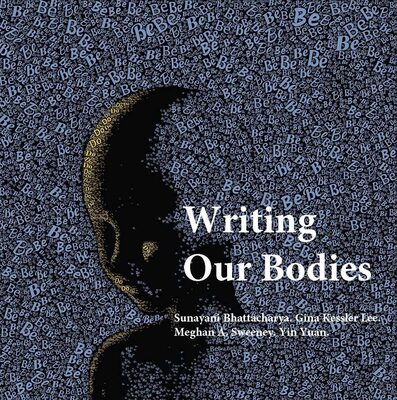
Writing Our Bodies
Sunayani Bhattacharya, Gina Kessler Lee, Meghan A. Sweeney, and Yin Yuan
Writing Our Bodies offers students a holistic approach to writing that intertwines embodied rhetorics with critical inquiry and academic conventions. Beginning with an introduction to rhetorical embodiment and personal experience, the text guides learners through writing to analyze, take a stand, revise, synthesize sources, and make arguments with research, while attending to how identity, technology, linguistic diversity, and power influence both reading and writing. Emphasizing reflection, audience awareness, disciplinary literacy, and ethical source use, this resource prepares students to write purposefully across contexts and audiences.
-

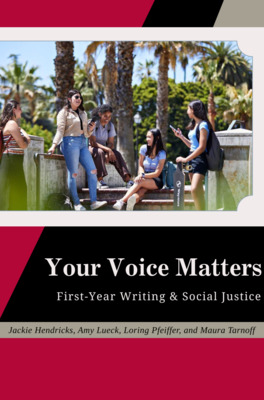
Your Voice Matters
Jackie Hendricks, Amy Lueck, Loring Pfeiffer, and Maura Tarnoff
Your Voice Matters: First-Year Writing and Social Justice frames writing as both an intellectual and community-oriented practice rooted in identity, audience awareness, and ethical engagement. Beginning with personal ways of knowing and the social construction of language, the text advances through public writing for social change, research methods grounded in justice, rigorous source collection and analysis, and strategies for making scholarly conversation visible and meaningful to real audiences. By foregrounding positionality, linguistic justice, and multi-modal strategies for public communication, this book equips students with the critical tools and reflective practices necessary for producing purposeful, public-facing writing.
The OER for Social Justice grant supported faculty at four California private universities in creating openly licensed, equity‑centered educational resources. Funded by the U.S. Department of Education, the program enabled 11 faculty teams to design OER for high‑enrollment courses that integrate diversity, equity, inclusion, accessibility, and anti‑racist frameworks. These openly licensed materials will remain freely available, expanding access to affordable, inclusive learning long beyond the grant period.
Printing is not supported at the primary Gallery Thumbnail page. Please first navigate to a specific Image before printing.