-
Bilingual Authorization Program Standards Content Analysis White Paper
Bilingual Standards Refresh Work Group
This white paper was developed in consultation with the Bilingual Authorization Working Group and reviews the 2009 California Commission on Teacher Credentialing (CTC) Bilingual Authorization Program Standards (BAPS). The analysis included current research in the field of bilingualism, equity, and dual language education. This Working Paper was presented to the CTC to influence and support efforts to update the BAPS. For each of the first set of five program standards, the authors offer: (1) descriptions of key elements within the standard; (2) recommended revisions; and (3) implications related to assessment, policy, and practice. The authors accepted standard 6 as written. Key recommendations included addressing the absence of field work and clinical experience. This paper includes a glossary of terms as well as an extended reference list across a variety topics in bilingual education.
-
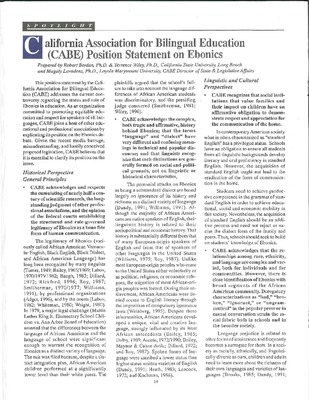
California Association for Bilingual Education (CABE) Position Statement on Ebonics
Robert Berdan Ph.D., Terrence Wiley Ph.D., and Magaly Lavadenz
In this position statement, the authors write in support of Ebonics (also known as African American Vernacular English, Black English, Black Dialect, and African American Language) as a legitimate language. The linguistic and cultural origins of Ebonics is traced, along with its legitimacy by professional organizations and the courts. CABE asserts that the role of schools and teachers is therefore to build on students’ knowledge of Ebonics rather than replace or eradicate Ebonics as they teach standard English. This position statement has implications for teacher training.
Printing is not supported at the primary Gallery Thumbnail page. Please first navigate to a specific Image before printing.