
-
Content-Based English Language Development Instruction Through Evidence-Based Practices Advancing Comprehensive English Language Development (ELD) Implementation Brief Series
Neida Ahmad Ph.D., Linda R. G. Kaminski Ed.D., Aline Matias, Elvira G. Armas Ed.D., and Magaly Lavadenz Ph.D.
Advancing Comprehensive English Language Development: Content-Based Instruction Through Evidence-Based Practices is the first in a four-part series assisting educational agencies in implementing high-quality, comprehensive English Language Development (ELD) systems. This brief bridges the gap between research and practice by illustrating what implementation looks like for evidence-based practices for content-based ELD curriculum, instruction, and assessment. It introduces a framework of foundational practices—understanding students' backgrounds and aligning instruction to standards—alongside four critical domains: Rigorous and Relevant Curriculum, Interactions, Comprehensibility, and Connections. Finally, the brief outlines the leadership and collaborative systems necessary to sustain these practices and improve long-term outcomes for English Learners.
-
Designing System Coherence For Content- Based English Language Development
Jeimee Estrada-Miller, Aline Matias, Raquel Gonzalez, Magaly Lavadenz, and Elvira G. Armas
Advancing Comprehensive English Language Development: Designing System Coherence for Content-Based English Language Development is the second in a four-part implementation series focused on advancing high-quality English language development (ELD) systems. Drawing on research on educational change, organizational coherence, and instructional improvement, the brief recognizes that while effective classroom practices are essential, their impact depends on the organizational conditions that support consistent implementation. This brief examines the "how" of implementation by emphasizing system coherence—the intentional alignment of policies, leadership, organizational structures, and resources around a shared vision for language and content learning. It introduces seven foundational practices that support the coherent implementation of content-based ELD at scale, including leadership alignment, instructional guidance, professional learning, and continuous improvement. Illustrative "Bright Spots" from state, district, and school systems across the country demonstrate how educational organizations are translating policy and research into coherent implementation strategies. By synthesizing evidence-based practices, field examples, and actionable implementation resources, the brief provides education leaders with a framework for aligning initiatives, strengthening organizational capacity, and creating the conditions necessary to implement evidence-based content-based ELD consistently across classrooms.
-
Designing System Coherence for Designated English Language Development
Raquel Gonzalez, Ph.D.; Magaly Lavadenz, Ph.D.; Elvira G. Armas, Ed.D.; Jeimee Estrada-Miller; and Britt Jung
Designing System Coherence for Designated English Language Development is the fourth and final brief in a series designed to guide state, regional, and local educational agencies in establishing equitable, high-quality comprehensive English Language Development (ELD) systems. The brief examines the organizational infrastructure, leadership, and resource alignment needed to scale and sustain high-quality designated ELD. An adapted framework of seven interconnected foundational practices guides the discussion of how educational leaders can protect instructional time, support sustained professional learning and coaching, and connect designated ELD to grade-level academic content. The brief also examines systemic coherence across three levels—state education agencies, local education agencies, and school sites—identifying opportunities to strengthen alignment and address institutional fragmentation. To offer practical models for implementation, the brief features state and district Bright Spots—highlighting systemic initiatives in California, Alabama, Azusa Unified School District, and Decatur City Schools—that illustrate how strategic leadership and coordinated policies have the potential to strengthen English language proficiency and academic achievement for multilingual learners.
-
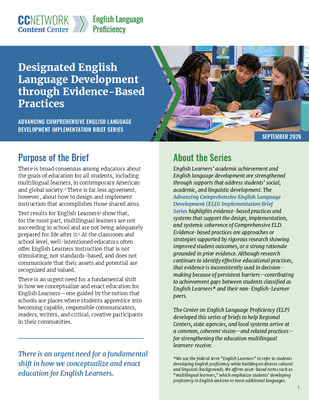
Designated ELD through Evidence-Based Practices
Aida Walquí, Ph.D. and Magaly Lavadenz, Ph.D.
Designated English Language Development through Evidence-Based Practices is the third in a four-part series assisting educational agencies in implementing high-quality, comprehensive English Language Development (ELD) systems. This brief bridges the gap between research and practice by illustrating what implementation looks like for evidence-based practices in Designated ELD (DELD) curriculum and instruction. It introduces an ecological model of learning—conceptualizing education across macro- and micro-systems—alongside five fundamental shifts in classroom practice: Teaching as Apprenticeship, Language as Action, No Isolated Language Practice, Non-Linear Spiraling Design, and Vocabulary Taught in Context. Additionally, the brief outlines key guidelines for heterogeneous group composition and a productive DELD three-moment lesson design (Preparing Learners, Interacting with Text, and Extending Understanding). Finally, the brief showcases classroom "Bright Spots" and details the collaborative structures necessary to sustain these practices and improve long-term outcomes for multilingual learners.
These action-focused implementation briefs translate evidence into practice by clearly outlining what educators and system leaders can implement. They provide practical actions, exemplars, and tools to apply research, align policy and instruction, and improve outcomes for English Learners. These briefs were developed by the Center on English Language Proficiency, a partnership between the Center for Equity for English Learners at Loyola Marymount University and Education First through a federally funded grant.
Printing is not supported at the primary Gallery Thumbnail page. Please first navigate to a specific Image before printing.